Showing posts with label landscape architecture. Show all posts

Tuesday, December 19, 2006

understanding nature


i was first introduced to stacy levy's work while studying landscape architecture at penn state university (she is the wife of my landscape ecology professor neil p. korostoff). stacy was a huge source of inspiration to me in her integration of art, science, and landscape ecology and her apt for creating visual metaphors for otherwise invisible processes. so i was very excited to see her featured on the cover of this month's sculpture magazine with a nice spread titled "stacy levy, understanding nature".

as a scientist and artist, stacy brings a fresh approach to land art through her visually seductive forms while incorporating environmental education and awareness. working with natural elements of water, wind, tides, pollution, decay and microorganisms, stacy designs her projects so to allow the sites and elements themselves to tell their stories of place and progression of natural processes.

"I am interested in showing the invisible aspects microorganisms and their complicated relationships of eating and being eaten, the spiraling hydrological patterns of a stream, the mosaic of growth in a vacant lot, the prevailing winds and their effects on vegetation, the flow of water through a living system. Often people think that nature ends where the city begins. But natural processes are always occurring in the city. I like to explore the idea of nature in the city and make it visible to people. I look for sites which give me the opportunity to bring the patterns and processes of the natural world into the built environment."

the following are examples of her work:

tide flowers


the hudson river rises twice a day with the eternal motion of the tides, connecting us in the urban fabric to the ocean, the moon, and natures' own daily schedule. emphasizing nature's constant hand in the urban environment, tide flowers is an installation of colorful flowers which "bloom" at high tide and close at low tide on the hudson river.


acid mine drainage & art, projects for vintondale


acid mine drainage (amd) pollutes hundreds of miles of streams in the coal mining country of pennsylvania. this issue is close to my heart, as my fifth-year capstone project for psu was the transformation of an 80 acre site intensely polluted by amd into a healthy community park.

collaborating with a landscape architect, a geologist, and a historian on acid mine drainage in vintondale, pennsylvania, levy explained the effect of coalmines on the environment, while creating a park and a passive water treatment facility to restore nature to its pre-industrial state. "the design of the water treatment wetlands brings the massive scale of the mining operation back to the site, with raised plinths of soil demarcating the footprints of the original mine buildings. the final rinse of the water is through the series of wetlands allowing the water to slowly seep back into the blacklick creek."


river eyelash


installed for the three rivers arts festival in my hometown, pittsburgh pa, stacy used 3,000 painted buoys to create strands of an eyelash for the city from the tip of point state park. "the eyelash floats where the concrete of the city meets the fluid edge of the water, engaging the great open surface of the three rivers." the floating strands constantly change in response to wind direction, speed of the currents and types of waves.

Sunday, November 19, 2006

santa monica takes the leed in greening parks


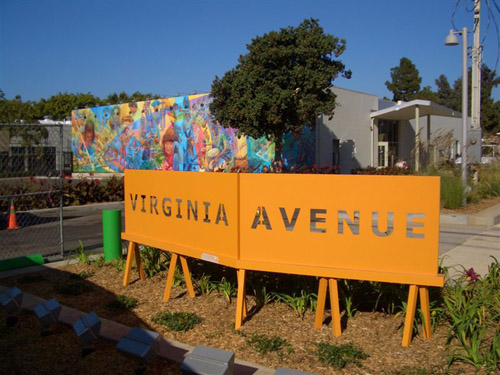
did you know that the first park in the united states to be awarded a LEED certification is right in our backyards? me neither, but virginia avenue park in santa monica was awarded a silver rating from the u.s. green building council for it's 9.5 acre addition in 2005.

one may think that it would be a cinch for a park to get a LEED award for environmental sustainability...it's green right? but many traditional parks are constructed and operated using wasteful systems such as grading and demolition, over-irrigation, and chemical fertilizers. even the plants that are chosen have a big impact on the "greenness" of a landscape plan.

koning eizenberg architecture of santa monica and spurlock poirier landscape architects of san diego obviously understood this in their design process for the urban park. the park at virginia avenue took advantage of sustainable techniques such as rainwater capture and use, construction waste recycling, efficient irrigation and electricity (all energy is supplied by renewable power), drought tolerant plantings, natural ventilation, and four recharching stations for alternative fuel vehicles. also, all paint, wood, and carpet materials were specified sans volatile compounds or formaldehyde.

LEED certified building is getting a lot of press (and rightfully so) but it's great to see parks joining in the mix.

(via garden design magazine nov 2006)

Friday, October 27, 2006

urban greening

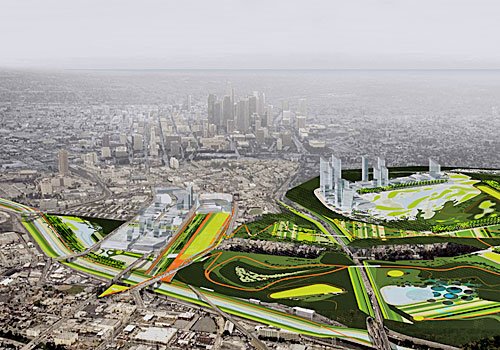
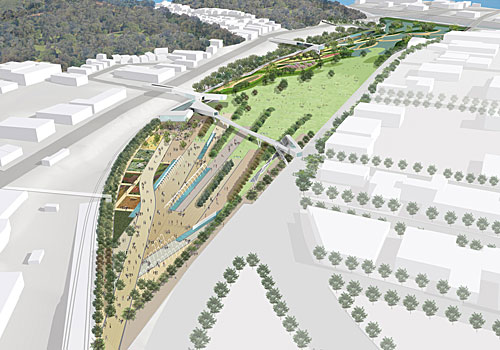
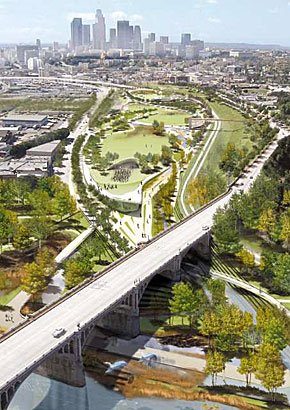
out of 33 design firms recently submitting entries for a new 32-acre state historic park on the not a cornfield site in downtown el lay, the entries from new york-based field operations, hargreaves associates of san francisco and mia lehrer and associates of los angeles have come out on top...and each with quite different proposals reports the latimes.

i definitely see the benefit in field operation's radical proposal, which includes relocating dodger's stadium to the not a cornfield site, in getting people to think outside of the box. the city needs progressive vision, as the latimes says, "to keep us from falling back into the kind of default planning mode that focuses on the short term."

however, on a sustainability front, i see more benefit in a plan such as hargraves' which makes a green statement for the city with it's low-slung structures covered with photovoltaic panels and a series of wetland habitats reaching out to the los angeles river.


mia lehrer's design calls for a similar elegant transition from urban to natural and symbolically utilized the leaf-shape of the site. lehrer's firm also benefits from the knowledge of the area from working on a new master plan for the l.a. river.

eventhough funding for the project is still up in the air, (the outcome of proposition 84 will have a big impact on this), the chosen team will ultimately make a huge statement for the city of los angeles. it is really exciting how much this competition has raised awareness and discussion about urban planning in los angeles, and has people visualizing great green possibilities beyond the current concrete jungle.

check out worldchanging for a great article about "remaking l.a.".